
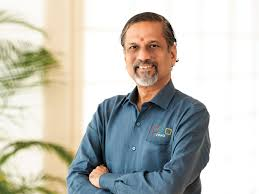
Sridhar Vembu.
Walked out of Princeton, walked away from Silicon Valley, walked home. Then built a $6B software company from a Tamil village — without a single rupee of outside funding.
journey
Born in Thanjavur, Tamil Nadu in 1968, Sridhar Vembu finished a BTech in electrical engineering at IIT Madras in 1989 and shipped out to Princeton for a master's and PhD under Sergio Verdú, defending in 1994. From Princeton he took the obvious next step — a wireless-engineering job at Qualcomm in San Diego — and then, in 1996, made the unobvious one: he and two of his brothers started a small enterprise-software company called AdventNet, betting that durable technology businesses could be built out of India without venture capital. Thirteen years later, in 2009, AdventNet renamed itself Zoho and shifted its center of gravity toward a sprawling SaaS suite.
struggles
The choice not to raise was unfashionable for two decades. While Vembu's peers were optimizing for the next funding milestone, Zoho ran on its own cash, built more slowly than the venture-backed playbook allowed, and shipped product after product into a market that mostly hadn't heard of it. The company has never been profitable on the headline scale Silicon Valley likes to celebrate — but it has been profitable every year, in a category where most VC-backed competitors are not. The other long bet was geographic. In 2019, Vembu permanently relocated to Mathalamparai in Tenkasi district, Tamil Nadu, and began the slow work of rerouting Zoho's operational center from cities to villages.
success
Forbes pegged the combined Vembu-family net worth at roughly six billion dollars in October 2025, with Sridhar and his siblings sitting inside India's top fifty richest. Zoho competes globally against Microsoft, Google, and Salesforce; its CRM alone has tens of millions of users, and the broader product catalog spans CRM, mail, accounting, project management, analytics, and dozens more. The company has never taken outside capital. In 2021, the Government of India awarded Vembu the Padma Shri and appointed him to the National Security Advisory Board. He was Ernst & Young Entrepreneur of the Year in 2019 and shared CNN-News18's Indian of the Year (Start-ups) with Tony Thomas in 2022.
lessons
Vembu's public writing and interviews return to a small set of operating ideas. That funding is a tool, not a goal — and a contract about time more than about money. That India's tier-three towns are full of intelligent young people whose only obstacle was that no one had built them a path. That compounding is the only real moat in enterprise software, and that you only get to compound if you opt out of the time horizons your competitors agreed to. He has run Zoho Schools — a tuition-free, stipend-paying training program for high-school graduates from rural Tamil Nadu — since 2004. A meaningful share of Zoho's engineers came through it.
Track record
Operating principles
VC money is a contract about time.
Vembu has said in interviews that the cost of a venture round is the time horizon you agree to in exchange for it. For a slow-compounding enterprise-software business, that horizon is usually shorter than the one the business actually needs.
Talent isn't only in cities.
The 2019 move to Tenkasi was an operating thesis — that intelligent young people in tier-three Indian towns can ship world-class software if someone builds them the training pipeline.
Build for decades.
Zoho's competitors spent more on sales and marketing every quarter. Zoho's retention was higher every quarter. Over a hundred quarters, that gap compounds into a $6B company that owns its own destiny.
Tell your network. Pre-filled text for LinkedIn and X — edit however you like.
Copy and paste this into your site or bio page.
<a href="https://theentrepreneurstory.com/founders/sridhar-vembu" target="_blank" rel="noreferrer" style="display:inline-flex;align-items:center;gap:8px;background:#1a2e1a;color:#f4efe1;font-family:sans-serif;font-size:13px;padding:10px 16px;border-radius:4px;text-decoration:none;">As featured in · The Entrepreneur Story</a>Selected coverage
Want your story here?
Submit your founder profile.
Like Sridhar, hundreds of founders have been featured on The Entrepreneur Story. Reviewed weekly — submit yours in under two minutes.
Submit your story →