
The man who built a $6 billion company from a village.
Sridhar Vembu walked out of Princeton, walked away from Silicon Valley, and walked home. Then he built one of India's most valuable software companies — without raising a single rupee of outside funding.
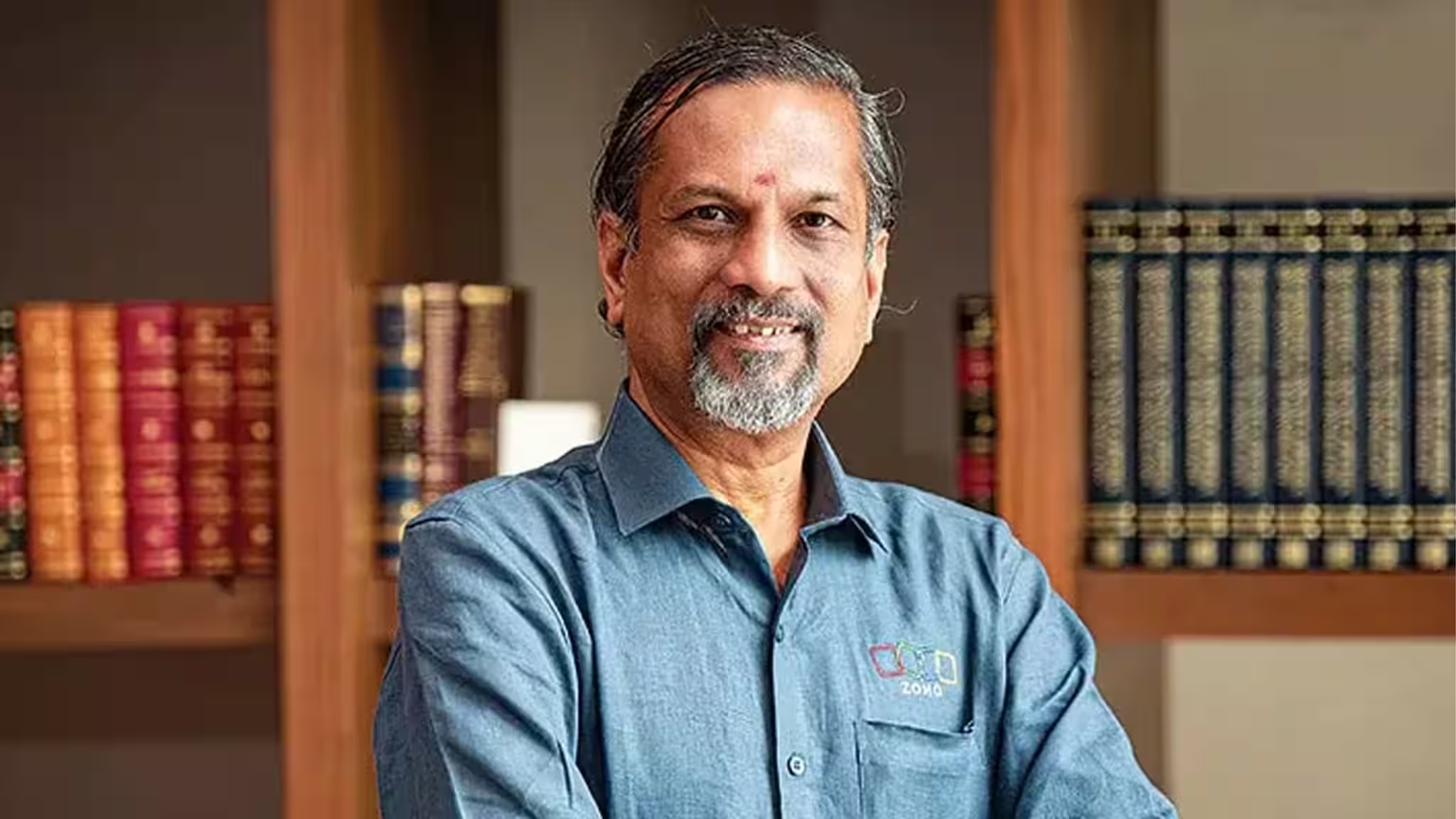
In 1989, a young engineer from Thanjavur named Sridhar Vembu finished his bachelor's degree at IIT Madras. He flew to New Jersey, enrolled at Princeton, and spent the next five years earning a PhD in electrical engineering. After Princeton, he did what almost every other foreign graduate did: he moved west, and took a job at Qualcomm in San Diego.
That's the part of the story that follows the script.
The part that doesn't is what happened next.
In 1996, Vembu and two of his brothers started a small software company called AdventNet. They were betting on a thesis most of his peers thought was naive — that you could build a serious technology business out of India, without venture capital, without a Silicon Valley address, and without the operating playbook every other startup in his generation was following.
Twenty-three years later, in 2019, he packed up his life in the Bay Area and moved to Tenkasi — a village in southern Tamil Nadu, roughly 600 kilometers from Bangalore. He didn't move his family there as a sabbatical or a vanity project. He moved the headquarters of the company.
That company is Zoho. Forbes pegs the combined net worth of Vembu and his siblings at around six billion dollars. It competes globally against Microsoft, Google, and Salesforce. It is, by most measurements, one of the most valuable privately-held software businesses ever built in India.
And it has never taken outside capital.
The case against the obvious path
To understand the choice Vembu made, you have to understand the choice he was being offered.
The Silicon Valley playbook for a founder like him in 1996 was already well-formed. Raise a seed round, build an MVP, raise a Series A, hire aggressively in the Bay Area, optimize for the next funding milestone, eventually sell to a strategic acquirer or go public. The path was a conveyor belt, and the conveyor belt worked.
Vembu's argument against it was not ideological. It was structural.
Venture capital, in his view, was a contract about time. When you take a round, you're agreeing to grow at a specific rate, within a specific window, to deliver a specific outcome to the people who funded you. That contract is fine if your business model rewards the same time horizon. It is brutal if it doesn't.
Zoho's business model was a long compounding curve. Enterprise software with sticky customers, low churn, and forty-product breadth that takes a decade to build. Every dollar of venture funding would have shortened the time horizon Zoho actually needed. So Vembu refused them.
Ambition and patience together are more powerful than ambition and funding.
There is no romantic version of this story. He has said in interviews that he wasn't trying to make a statement. He was trying to do math. The math said that if Zoho could survive without outside capital, it would own its destiny. So it did.
What happens when you build for thirty years
In 2009, AdventNet renamed itself Zoho. By then it was already profitable, already growing, and already exporting business software from Chennai to customers in 180 countries. It had not made the cover of TechCrunch. It had not raised a single round. Most of Silicon Valley had no idea it existed.
In the years that followed, Zoho did what slow-compounding businesses do. It got bigger. Quietly. Relentlessly. Today its product catalog is so wide — CRM, accounting, mail, project management, analytics, dozens more — that competitors find it easier to describe what Zoho doesn't make than what it does. The flagship CRM alone has tens of millions of users.
When Salesforce acquired Slack in 2021 for nearly $28 billion, much of the conversation was about consolidation in the enterprise SaaS market. Zoho, building the same kind of software for two decades by then, didn't issue a press release. It kept shipping.
This is what compounding looks like when you protect it from the wrong kind of pressure. Zoho's growth chart is not the hockey stick that venture-backed companies need to justify their valuations. It is something slower, steadier, and harder to manufacture. It is the chart of a business that was allowed to be patient.
The move
In 2019, Vembu made the decision that turned a quiet business story into a quiet cultural one.
He moved to Tenkasi. Not on weekends, not as a retreat. Permanently. His office became a building in a village. He started spending his weekdays in rural Tamil Nadu, riding around on a bicycle, talking to local farmers, and slowly rerouting his company's operational center toward places like the one where he'd grown up.
The decision wasn't about cost arbitrage. Zoho could afford to operate anywhere. It was about something Vembu had been saying for years and finally had the conviction to act on: that the assumption talent only lives in cities was wrong, and that India's tier-three towns were full of intelligent young people whose only obstacle was that no one had given them a path.
So he gave them one.
Zoho Schools
The school is the part of the story most founders miss.
Around the time he moved to Tenkasi, Vembu was already running Zoho Schools — a program that takes high-school graduates, many of them from rural Tamil Nadu, and trains them to become professional software engineers. The students don't pay tuition. They aren't required to have a college degree. They earn a stipend while they learn. After two years they begin working on actual Zoho products.
Today, a meaningful share of Zoho's engineering workforce came through this pipeline. Many of them never went to college at all. They are shipping software that competes with products built by engineers at Microsoft, Google, and Salesforce.
This is not a charity program. It is a strategy. The cost of training a Zoho Schools graduate is a fraction of the cost of hiring a senior engineer in San Francisco. The retention rate is higher. And — this is the part Vembu has been trying to communicate to the broader industry for a decade — the work is just as good.
The implication is uncomfortable for a lot of the technology industry. If you can build world-class software with self-taught engineers from rural villages, then the cost structure of Silicon Valley starts to look less like a moat and more like a tax.
Three lessons from the playbook
If you compress thirty years of Vembu's operating decisions into the version that fits on a slide, three patterns hold:
VC money isn't the goal. Funding is a tool, not an achievement. It buys time, but the price is time itself — the contract you sign about when results have to arrive. Vembu's bet was that for the right kind of business, the cost of that contract is higher than the cost of going without.
Talent isn't only in cities. The geographic centralization of the technology industry is a recent phenomenon, and Vembu is one of the few founders who has seriously stress-tested whether it was necessary. His answer, after two decades of evidence, is no.
Build for decades, not quarters. Every quarter, Zoho's competitors spent more on sales and marketing than Zoho did. Every quarter, Zoho's customer retention was higher. Over a hundred quarters, that gap compounds into a company.
None of these are slogans. They are the operating decisions of a business that has been running long enough to have data.
The thesis
Vembu rarely speaks in absolutes, but the closest thing he has to a thesis, repeated in different forms across interviews over the years, is this: ambition and patience together are more powerful than ambition and funding.
It is a heretical idea in a culture that has spent two decades treating the size of a Series A as a proxy for the quality of an idea. It is also, looking at the numbers, hard to argue with. Zoho is profitable. It is global. It is one of the highest-valued private software companies ever built outside the United States. And the founder lives in a village.
The lesson is not that everyone should move to a village. The lesson is that the conventional path is one path among many, and that the founders who are most likely to build something durable are the ones who decide which constraints to accept and which to refuse.
Vembu chose to refuse most of them. Then he spent thirty years proving the choice.
Continue reading



The Entrepreneur Story
Is your story worth telling?
We feature founders who are building something real. Apply and we'll be in touch.
Apply to be featured →Stay sharp.
Ideas that move.
Founder stories, emerging ventures, and essays on what's next — straight to your inbox.
Unsubscribe any time.