
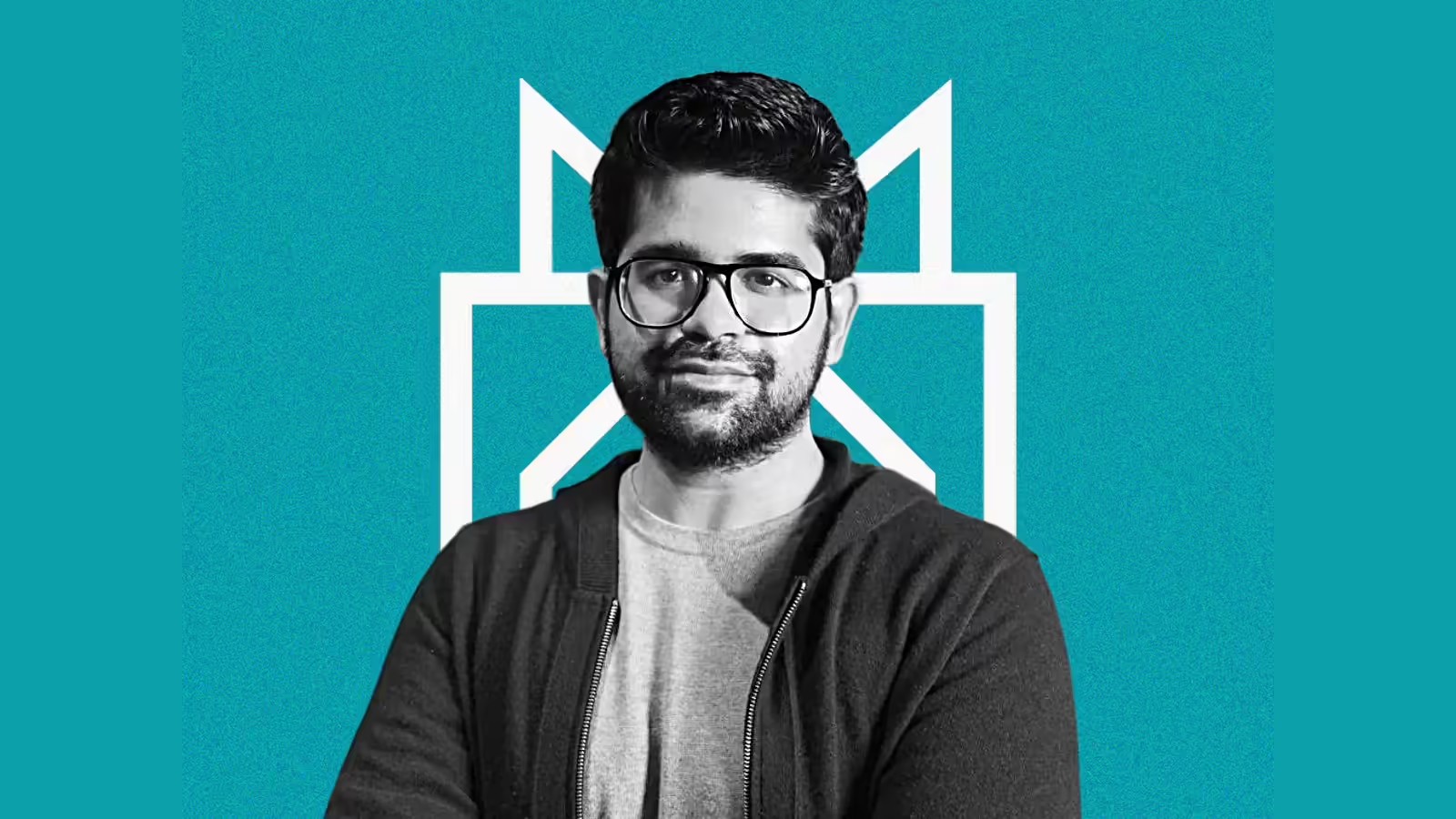
Aravind Srinivas.
Left Berkeley, left OpenAI, and built the first AI-native search engine — Perplexity — that took Google's most defended product and treated it like a research problem.
journey
Aravind Srinivas grew up in Chennai, finished his BTech in electrical engineering at IIT Madras in 2017, and shipped out to Berkeley for a PhD under Pieter Abbeel. His doctoral years were spent inside the deep-learning lab that produced most of the early reinforcement-learning research that shaped the modern AI stack. He interned at OpenAI, DeepMind, and Google Brain during that window — three of the four labs that defined where the field was going — and graduated in 2021 with a thesis on self-supervised learning. The obvious next step was to take a research job at one of those labs. Instead, in August 2022, he co-founded Perplexity with Denis Yarats (also ex-Facebook AI), Johnny Ho, and Andy Konwinski. The bet was specific: that the next interface for the open web wouldn't be ten blue links, it would be a paragraph with citations.
struggles
Perplexity launched into the most defended product surface in technology. Google Search generates the cash flow that funds the rest of Alphabet; rebuilding it requires either crawling the web independently (legally and operationally hard) or sitting on top of Google's index and hoping not to be cut off. The early Perplexity product did the latter, then progressively built its own crawl. Every competitive announcement from Google — SGE, then AI Overviews — was framed by the press as a Perplexity-killer. The litigation pressure has been real: News Corp and other publishers have filed copyright suits over how citation-summarization works. And the unit economics of running large-language-model inference for every search query make the cost structure dramatically worse than Google's, at least until inference costs collapse.
success
Perplexity raised across a sequence of rounds in 2024 and 2025 led by IVP, NEA, Bezos Expeditions, NVIDIA, and SoftBank; press reports across the year placed the valuation in the multi-billion range, climbing from roughly $1B in early 2024 to nine-figure and then ten-figure territory by late 2025. The product line expanded from a single answer box into Pages, Spaces, Discover, an enterprise tier, an Android-first browser called Comet, and a Mac assistant. Reported users crossed into the tens of millions of monthly actives. Srinivas himself became a category-defining figure for AI-native consumer software — the founder most often cited as proving you can build a meaningful product on the Google side of the table.
lessons
Srinivas's public commentary returns to a few ideas. That the model is not the product — the retrieval system, the UX, and the trust layer matter more than which LLM is under the hood, because the LLM commoditizes faster than the surface. That speed of iteration is the actual moat — Perplexity ships weekly, while Google ships in quarters. That you should pick a fight you can lose with grace — going head-on at Google was either going to make the company or end it cleanly, and either outcome was preferable to building a feature inside someone else's product. That competing for talent in San Francisco is harder than building the product, and that hiring is half the job of an AI-native CEO.
Track record
Operating principles
The model is not the product.
Models commoditize. The retrieval system, the UX, and the trust layer are where defensibility lives. Perplexity's bet was always that the index plus the interface mattered more than which LLM answered.
Ship weekly.
Incumbents ship in quarters. Startups ship in days. Compounding shipping velocity over 24 months is the difference between being a feature inside someone else's roadmap and being a category.
Pick a fight you can lose with grace.
Going head-on at Google was either going to make Perplexity or kill it cleanly. Either outcome beats building a feature inside someone else's product line and being slowly disassembled.
Tell your network. Pre-filled text for LinkedIn and X — edit however you like.
Copy and paste this into your site or bio page.
<a href="https://theentrepreneurstory.com/founders/aravind-srinivas" target="_blank" rel="noreferrer" style="display:inline-flex;align-items:center;gap:8px;background:#1a2e1a;color:#f4efe1;font-family:sans-serif;font-size:13px;padding:10px 16px;border-radius:4px;text-decoration:none;">As featured in · The Entrepreneur Story</a>Selected coverage
Want your story here?
Submit your founder profile.
Like Aravind, hundreds of founders have been featured on The Entrepreneur Story. Reviewed weekly — submit yours in under two minutes.
Submit your story →