
Steve Jobs.
The college dropout who got fired from the company he founded, then came back to build the most valuable business in history.
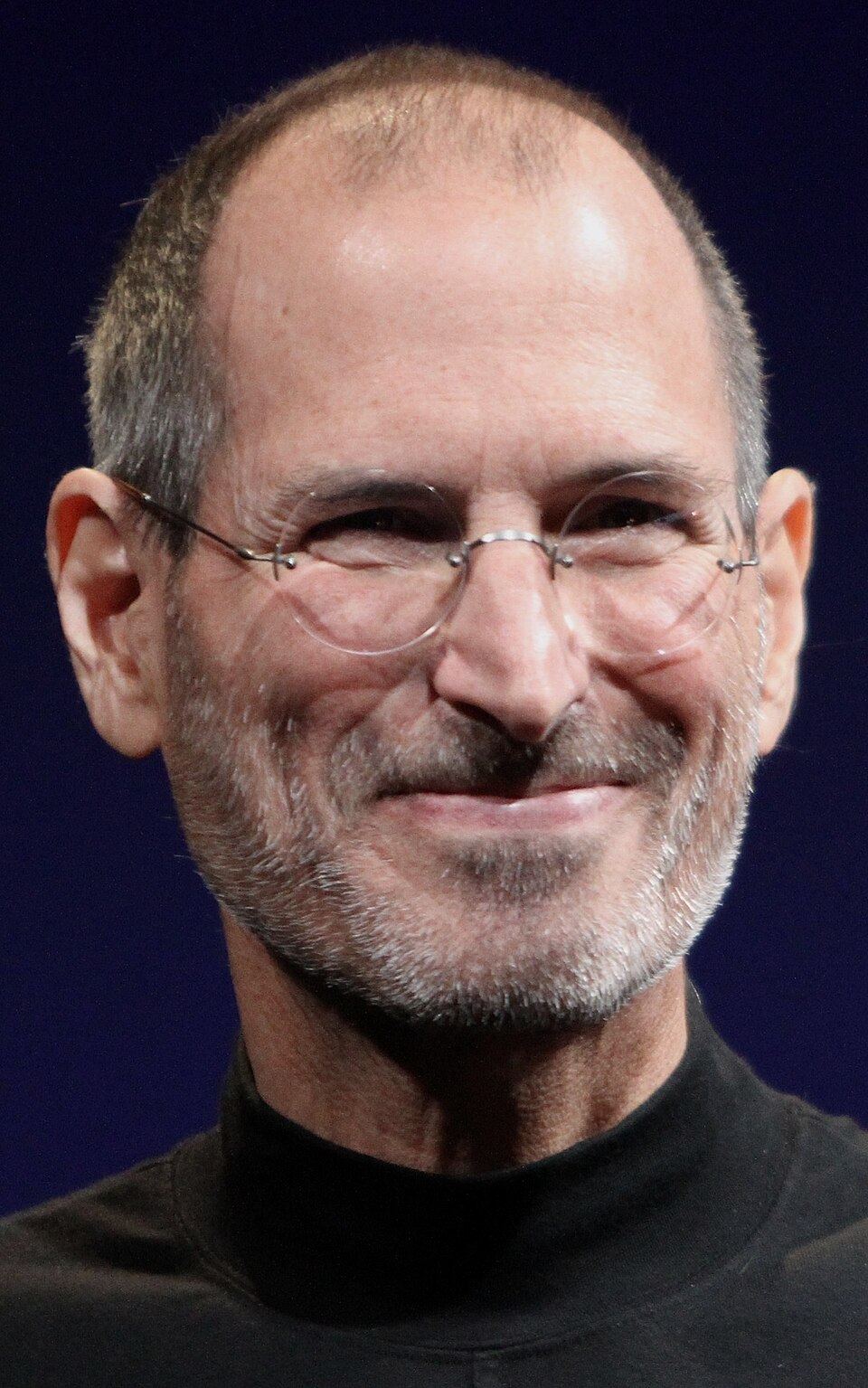
journey
Steven Paul Jobs was adopted at birth by Paul and Clara Jobs of Mountain View, California, in the heart of what would become Silicon Valley. He enrolled at Reed College in Portland, Oregon in 1972, dropped out after a single semester, and spent the next eighteen months dropping in on classes that interested him, including a calligraphy course he later credited with shaping Apple's typography. In 1974 he took a job at Atari to earn money for a spiritual pilgrimage to India, where he travelled for seven months, shaved his head and studied Zen Buddhism. Back in Los Altos, he partnered with his high-school friend Steve Wozniak, who had designed a small personal computer. On April 1, 1976, Jobs, Wozniak and Ronald Wayne founded Apple Computer Co. in the Jobs family garage. The Apple II, released in 1977, became one of the first mass-produced personal computers and carried the company to a 1980 IPO that made Jobs a multimillionaire at twenty-five.
struggles
Success did not soften him. By 1983 Jobs had recruited John Sculley from PepsiCo to run Apple, famously asking whether Sculley wanted to sell sugar water or change the world. Two years later the two had turned on each other. After the Macintosh underperformed sales targets and Jobs tried to engineer a boardroom coup, the directors sided with Sculley. On September 16, 1985 Jobs resigned, stripped of operational power inside the company he had built. He was thirty years old and, by his own later account, publicly humiliated. He founded NeXT the same year to build high-end workstations for universities and research labs; the hardware was elegant and expensive, the market was thin, and NeXT eventually abandoned hardware entirely. In 1986 he bought the computer graphics division of Lucasfilm for about ten million dollars and renamed it Pixar. For nearly a decade Pixar burned his money.
success
Pixar's break came in November 1995 with Toy Story, the first fully computer-animated feature film. A week after its release Pixar went public, and Jobs, who owned roughly eighty percent, became a billionaire. Apple, meanwhile, was collapsing. In December 1996 the company bought NeXT for roughly four hundred million dollars, bringing Jobs back as an advisor; by July 1997 he was interim CEO. He slashed the product line, launched the Think Different campaign, and in 1998 shipped the translucent iMac. Then came a run with few parallels in business history: iPod in 2001, the iTunes Store in 2003, iPhone in January 2007, the App Store in 2008, and iPad in 2010. In 2006 Disney acquired Pixar for about 7.4 billion dollars in stock, making Jobs its largest individual shareholder. He resigned as Apple CEO in August 2011 and died on October 5, 2011.
lessons
Jobs's career is the most useful founder case study of the modern era because almost every outcome was non-linear. He was not a coder. He was not formally trained. He was fired from his own company and spent twelve years in what looked, in real time, like failure. NeXT never scaled. Pixar bled money for a decade. The lesson is not that genius will out, but that compounding only works if you keep shipping. He used the exile years to learn what he had not learned the first time: how to run a company, how to delegate engineering, how to tell a story about a product that a stranger would repeat. When he returned to Apple he brought a sharpened taste, a smaller ego about implementation details, and an operating partner in Tim Cook. The arc argues for stamina over precocity.
Track record
Operating principles
Taste is a skill, not a gift
Jobs trained his aesthetic over decades, from a calligraphy class at Reed to type on the Mac to the glass staircases of Apple retail. He treated taste as something you develop through exposure, iteration, and the willingness to reject work that is almost right.
Say no more than you say yes
When he returned to Apple in 1997 the company sold dozens of overlapping products. He killed most of them and reduced the lineup to a four-quadrant grid: consumer versus pro, desktop versus portable. Focus, for Jobs, was addition by subtraction.
Own the whole stack when it matters
Jobs insisted on controlling hardware, software and, eventually, retail and distribution. The industry mocked it as inefficient until the integrated model produced the iPhone. Vertical integration, when the pieces must feel like one thing, is a competitive moat.
Tell your network. Pre-filled text for LinkedIn and X — edit however you like.
Copy and paste this into your site or bio page.
<a href="https://theentrepreneurstory.com/founders/steve-jobs" target="_blank" rel="noreferrer" style="display:inline-flex;align-items:center;gap:8px;background:#1a2e1a;color:#f4efe1;font-family:sans-serif;font-size:13px;padding:10px 16px;border-radius:4px;text-decoration:none;">As featured in · The Entrepreneur Story</a>Selected coverage
Want your story here?
Submit your founder profile.
Like Steve, hundreds of founders have been featured on The Entrepreneur Story. Reviewed weekly — submit yours in under two minutes.
Submit your story →