
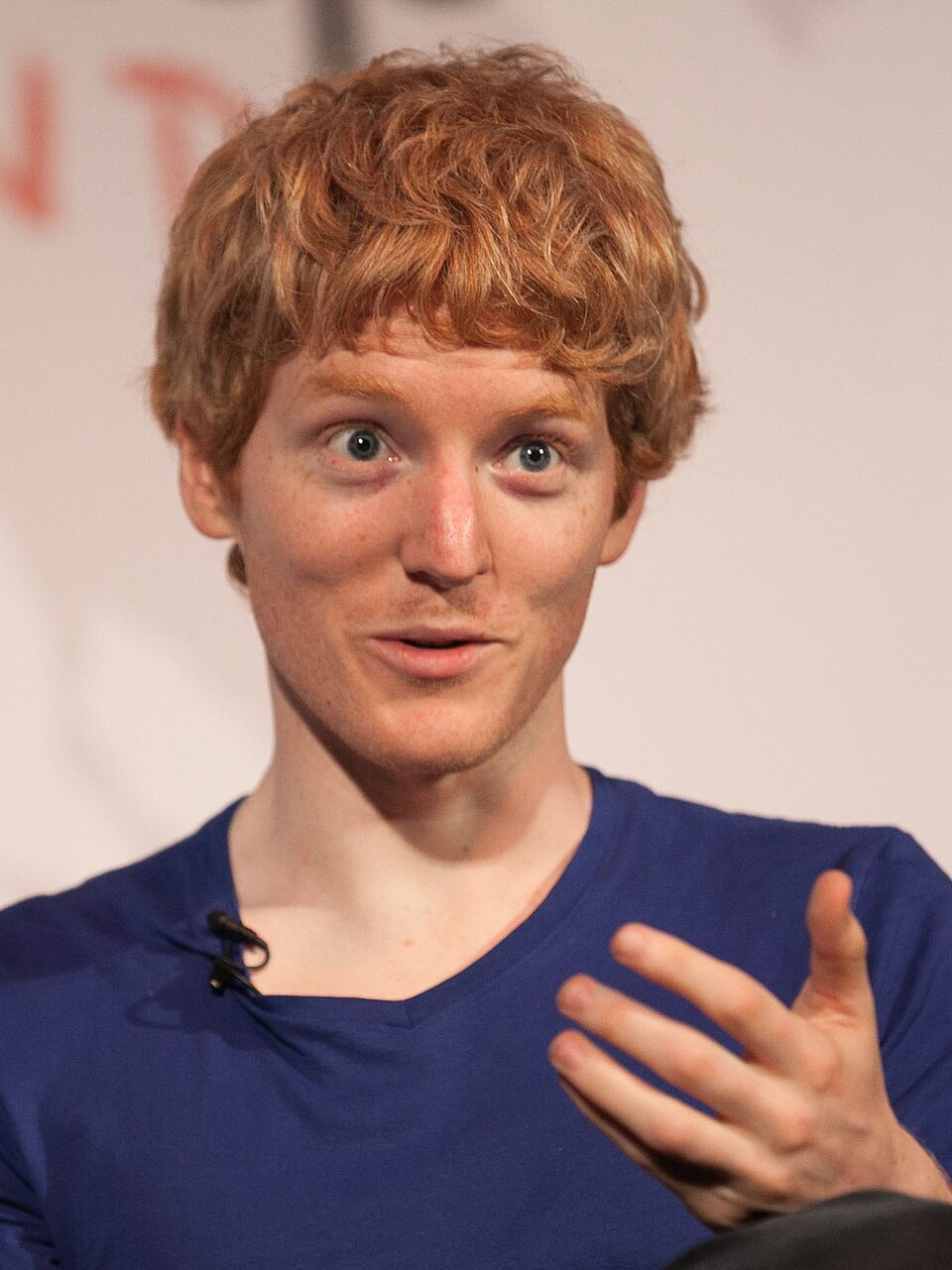
Patrick Collison.
Co-founder and CEO of Stripe, the payments infrastructure that quietly runs a sizable share of internet commerce.
journey
Patrick Collison grew up in Dromineer, a small village on Lough Derg in County Tipperary, the eldest son of an electronic engineer and a microbiologist. He was programming by age ten, and at sixteen he built Croma, a Lisp-like programming language, which won him the top prize at Ireland's 41st Young Scientist and Technology Exhibition in 2005. President Mary McAleese handed him a cheque for 7,500 euros and a Waterford Crystal trophy. He sat the SAT at thirteen, enrolled at MIT in 2006, and within months left to build Auctomatic, an eBay seller tool, with his brother John. Canadian firm Live Current Media bought Auctomatic in March 2008 for a reported $5 million. Patrick was nineteen. He went back to MIT to study maths and physics, then dropped out again, with John dropping out of Harvard, to go through Y Combinator's Summer 2009 batch and build what would become Stripe.
struggles
The early Stripe pitch was almost unserious on paper: two Irish teenagers in a Palo Alto apartment telling banks and card networks they wanted to rebuild merchant acquiring. Payments is a regulated industry where incumbents move at the speed of compliance committees, and the Collisons had neither the credentials nor the age to look credible. Early partner banks were hesitant to underwrite them. Processors already had entrenched integrations with developers' host-of-choice. The brothers also had to overcome the perception that payments was a solved problem — PayPal existed, Authorize.net existed, Braintree existed. Convincing engineers to swap a legacy gateway integration they had already suffered through was harder than it sounded. For months the pitch was almost entirely one-on-one: find a developer frustrated with the status quo, hand them the test keys, let the product do the arguing.
success
Stripe's bet — that developers, not procurement teams, would choose payment infrastructure — turned out to be the correct read of where software was going. By 2024 Stripe was processing over a trillion dollars in payment volume annually. An employee tender in February 2024 valued the company at $65 billion. A year later, in February 2025, a second tender lifted it to $91.5 billion, making Stripe one of the most valuable private companies in the world. Revenue hit $6.8 billion in 2025, up 33% year-on-year. Patrick is now a dollar billionaire, but has resisted taking the company public, arguing that the quarterly rhythm of public markets is a poor fit for infrastructure businesses whose growth is 'lumpy.'
lessons
Collison's career is a case study in what happens when you refuse to accept that an industry's complexity is load-bearing. Payments integration in 2010 took days or weeks because every incumbent assumed it had to. The seven lines of code that opened Stripe's documentation were not a technical breakthrough; they were a product decision — a bet that the apparent complexity was accidental, not essential, and that someone willing to absorb that complexity on the user's behalf could win a very large market. The lesson for founders: when every established player in a category agrees that something must be hard, that consensus is itself the opportunity. Audit the friction. Ask whether it exists because the problem demands it, or because no one has done the unglamorous work of hiding it. The best startups are often the ones that simply refuse to pass the mess downstream.
Track record
Operating principles
Complexity is almost always a choice
Legacy payments stacks were not hard because moving money is physically difficult. They were hard because no one had been punished for leaving the mess exposed. Stripe's wedge was absorbing that mess.
Build for the person who actually integrates you
Collison built Stripe for the developer at 2am, not the CFO in the quarterly review. If the end user of your product is an engineer, the docs are the product.
Patient capital beats quarterly theatre
Collison has repeatedly pushed back on IPO pressure, arguing infrastructure growth is lumpy and incompatible with managing to earnings-per-share. Pick the operating cadence the business actually needs.
Tell your network. Pre-filled text for LinkedIn and X — edit however you like.
Copy and paste this into your site or bio page.
<a href="https://theentrepreneurstory.com/founders/patrick-collison" target="_blank" rel="noreferrer" style="display:inline-flex;align-items:center;gap:8px;background:#1a2e1a;color:#f4efe1;font-family:sans-serif;font-size:13px;padding:10px 16px;border-radius:4px;text-decoration:none;">As featured in · The Entrepreneur Story</a>Selected coverage
Want your story here?
Submit your founder profile.
Like Patrick, hundreds of founders have been featured on The Entrepreneur Story. Reviewed weekly — submit yours in under two minutes.
Submit your story →