
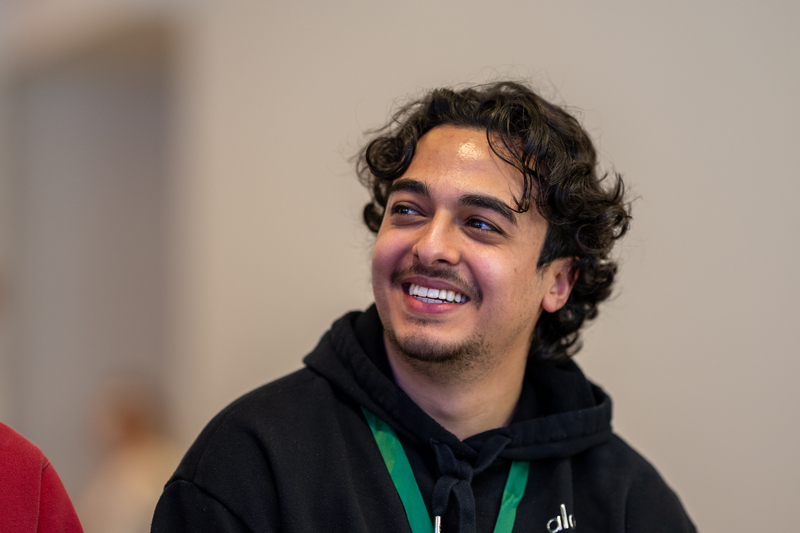
Nizar Abi Zaher.
Four weeks from law school, he chose engineering instead. Now he and co-founder Adam Wazzan are building the infrastructure that lets any company launch an AI agent on iMessage, WhatsApp, Slack, SMS, Telegram, or email in minutes.
journey
Nizar Abi Zaher was four weeks away from starting law school when he changed direction. He had spent the preceding months teaching himself engineering — not as a backup plan, but because the pull toward building had become stronger than the pull toward practising law. He chose not to go. That decision set the terms for everything that followed. His co-founder Adam Wazzan had always been a builder in the literal sense — hardware, software, anything that required making something that did not exist before. The two of them built Orchid, a personal AI assistant that became a Y Combinator Spring 2025 company, spending nine months solving for what nobody advertises about AI products: the messaging infrastructure, the memory, the tools, the hosting, and the endless ways things break after the demo works perfectly. They got it working. Then the companies started asking how.
struggles
The nine months building Orchid were not spent on the interesting parts. The AI models were already exceptional. The APIs were there. What required nine months was everything between a working demo and a reliable product: messaging infrastructure, memory management, tool integration, hosting, and the compounding failures that appear only when real users arrive. 'Nobody starts a company because they're passionate about debugging webhooks at 2 a.m.,' Nizar says. That gap — between what AI makes possible and what shipping actually requires — is exactly what Keiki is built to close. The infrastructure tax that Orchid cost them is the tax Keiki is designed to eliminate for every founder who comes after.
success
Keiki shipped on September 1, 2026. It lets companies build and deploy AI agents on iMessage, WhatsApp, Slack, SMS, Telegram, email, and other channels their customers already use — handling the infrastructure, so the founder can focus on the product and the customer. The team is five people: four focused on growth, one on engineering. That ratio is intentional, not accidental. The vision Nizar and Adam are working toward is the one that the biggest platform builders have already proven: WordPress made publishing accessible, Shopify made launching an online store accessible, and Keiki wants to do the same for agents. 'We believe every business will have an agent, just as businesses came to have websites,' Nizar says. 'Your next purchase might start with "hey."'
lessons
The clearest thing Nizar has said about building Keiki is about where value is shifting. 'We believe AI is making coding less of a bottleneck. Understanding customers, communicating clearly, and getting people to care are becoming even more valuable.' A 4:1 growth-to-engineering ratio at a five-person AI infrastructure company is not an oversight — it is a deliberate bet on that belief. The other lesson is structural: Orchid cost nine months to build because that infrastructure did not exist. Keiki's entire proposition is that the next founder should be able to start with their idea rather than spend the first year rebuilding the same foundation. The time between the idea and the product is where most momentum dies. Closing that gap is both the business and the point.
Track record
Operating principles
The next founder should start with their idea.
Orchid cost nine months of infrastructure work before it could be a product. That time is the tax every founder pays to reach the starting line. Keiki exists to eliminate that tax — so the next team can begin with what they're actually trying to build, not with what it takes to make it run.
Understand customers first.
A 4:1 growth-to-engineering ratio at an AI company is a statement about where the scarcity is. Coding is becoming less of a bottleneck. Knowing what people need, communicating it clearly, and earning their trust are not. The team reflects that belief.
Build what breaks after the demo.
The gap between a working demo and a reliable product is where most AI companies fail. Keiki was built by people who spent nine months in that gap — not as a research exercise, but because they had to ship. That experience is the foundation.
Tell your network. Pre-filled text for LinkedIn and X — edit however you like.
Copy and paste this into your site or bio page.
<a href="https://theentrepreneurstory.com/founders/nizar-keiki" target="_blank" rel="noreferrer" style="display:inline-flex;align-items:center;gap:8px;background:#1a2e1a;color:#f4efe1;font-family:sans-serif;font-size:13px;padding:10px 16px;border-radius:4px;text-decoration:none;">As featured in · The Entrepreneur Story</a>Selected coverage
Want your story here?
Submit your founder profile.
Like Nizar, hundreds of founders have been featured on The Entrepreneur Story. Reviewed weekly — submit yours in under two minutes.
Submit your story →