
Masayoshi Son.
The SoftBank founder who lost $70 billion in six months, then rebuilt his fortune on a single $20M bet on Alibaba.
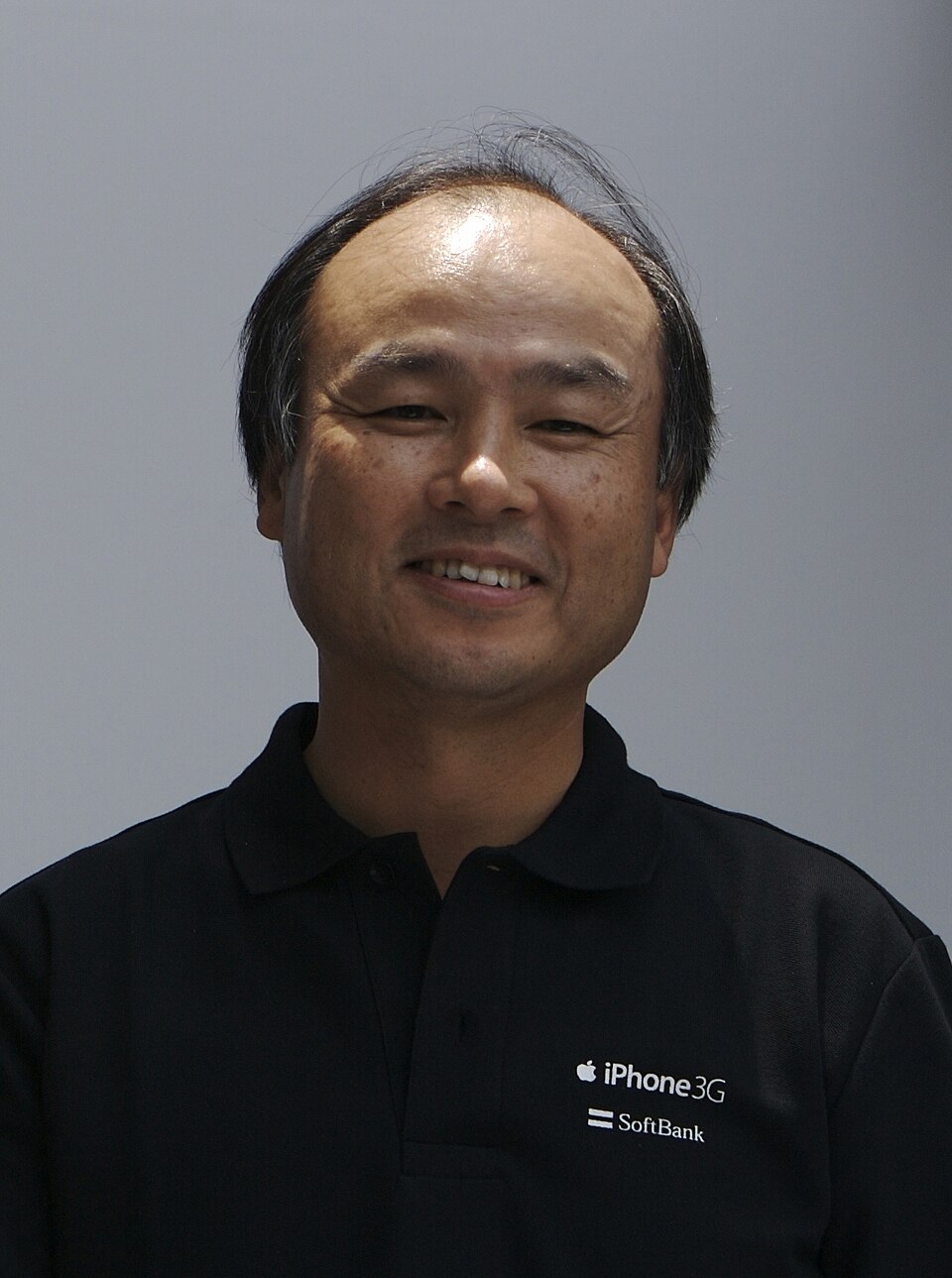
journey
Masayoshi Son was born on August 11, 1957, in Tosu, Saga Prefecture, to a Zainichi Korean family that faced steady discrimination in postwar Japan. His father raised pigs and chickens and later ran a small sake business. At fourteen, Son talked his way into a meeting with Den Fujita, the Japanese president of McDonald's, who told him to go to America and study computers. At sixteen, he left for California, finished high school, and enrolled at the University of California, Berkeley, graduating in 1980 with a degree in economics. While still a student, he and a small team built a prototype multilingual electronic translator. He licensed the device to Sharp Electronics for roughly $1 million, used the proceeds to seed his first ventures, and in 1981 returned to Japan to found SoftBank as a software distributor in Fukuoka with a handful of employees.
struggles
By February 2000, SoftBank's dot-com era investments had turned Son into one of the richest people on earth. His net worth hit roughly $78 billion, and for a brief window he was reported to be richer than Bill Gates. Then the bubble burst. Over the next six months SoftBank's share price collapsed, wiping out about 93% of the company's market value. Son personally lost close to $70 billion, dropping to around $1.1 billion at the low — widely described as the largest personal paper loss in history at the time. Rather than retreat, he refused to sell down his core positions, kept making concentrated bets, and spent the next decade grinding the business back. The crash reset his reputation but hardened a conviction style of investing that would define everything he did afterwards.
success
In October 2000, mid-crash, Son met Jack Ma, then running a little-known Chinese business directory called Alibaba. The meeting lasted roughly six minutes. Ma had no revenue and no clear plan, but Son offered to invest $40 million; Ma eventually accepted $20 million for a roughly 34% stake. By Alibaba's 2014 IPO, SoftBank's stake was worth more than $50 billion, and at its peak it exceeded $130 billion — one of the most profitable venture bets ever made. On that foundation Son launched the SoftBank Vision Fund in 2017, raising about $100 billion with anchor backing from Saudi Arabia's Public Investment Fund. The vehicle poured capital into Uber, ARM, DoorDash, Coupang and dozens of other platforms, cementing SoftBank as the single largest force in late-stage technology investing.
lessons
Son's career is a running argument for conviction over consensus. He writes extremely large cheques off a thesis he can describe in a sentence, then holds through drawdowns most investors would never tolerate. The Alibaba decision — a six-minute meeting, no revenue, no plan — is the clean example, but the same pattern runs through his bets on Yahoo Japan, ARM and the Vision Fund. The other lesson is time horizon. Son publicly frames SoftBank around a 300-year corporate vision, which sounds absurd until you realise it changes how he treats quarterly results and single-company losses. He treats volatility as the cost of entry for long-duration bets. His story also carries a warning: concentration cuts both ways, and the same conviction that produced Alibaba produced WeWork and the 2000 crash.
Track record
Operating principles
Invest in people before plans
Son has repeatedly described deciding on founders in minutes. His 2000 Alibaba cheque was written after a six-minute meeting with Jack Ma on gut, not projections. He treats conviction about the operator as the single highest-signal input.
Think in 300-year arcs
Son frames SoftBank around a stated 300-year corporate vision. Thirty-year losses, quarterly volatility and single-company blow-ups all look different when your planning horizon stretches across generations of successors.
Survive the downside first
Losing roughly $70 billion in six months and continuing to operate taught Son that staying in the game beats optimising any single trade. He kept his core positions, cut costs where he had to, and compounded back over the next two decades.
Tell your network. Pre-filled text for LinkedIn and X — edit however you like.
Copy and paste this into your site or bio page.
<a href="https://theentrepreneurstory.com/founders/masayoshi-son" target="_blank" rel="noreferrer" style="display:inline-flex;align-items:center;gap:8px;background:#1a2e1a;color:#f4efe1;font-family:sans-serif;font-size:13px;padding:10px 16px;border-radius:4px;text-decoration:none;">As featured in · The Entrepreneur Story</a>Selected coverage
Want your story here?
Submit your founder profile.
Like Masayoshi, hundreds of founders have been featured on The Entrepreneur Story. Reviewed weekly — submit yours in under two minutes.
Submit your story →