
Jensen Huang.
Co-founded Nvidia at a Denny's in 1993 and spent three decades turning a graphics-chip company into the infrastructure layer of modern AI.
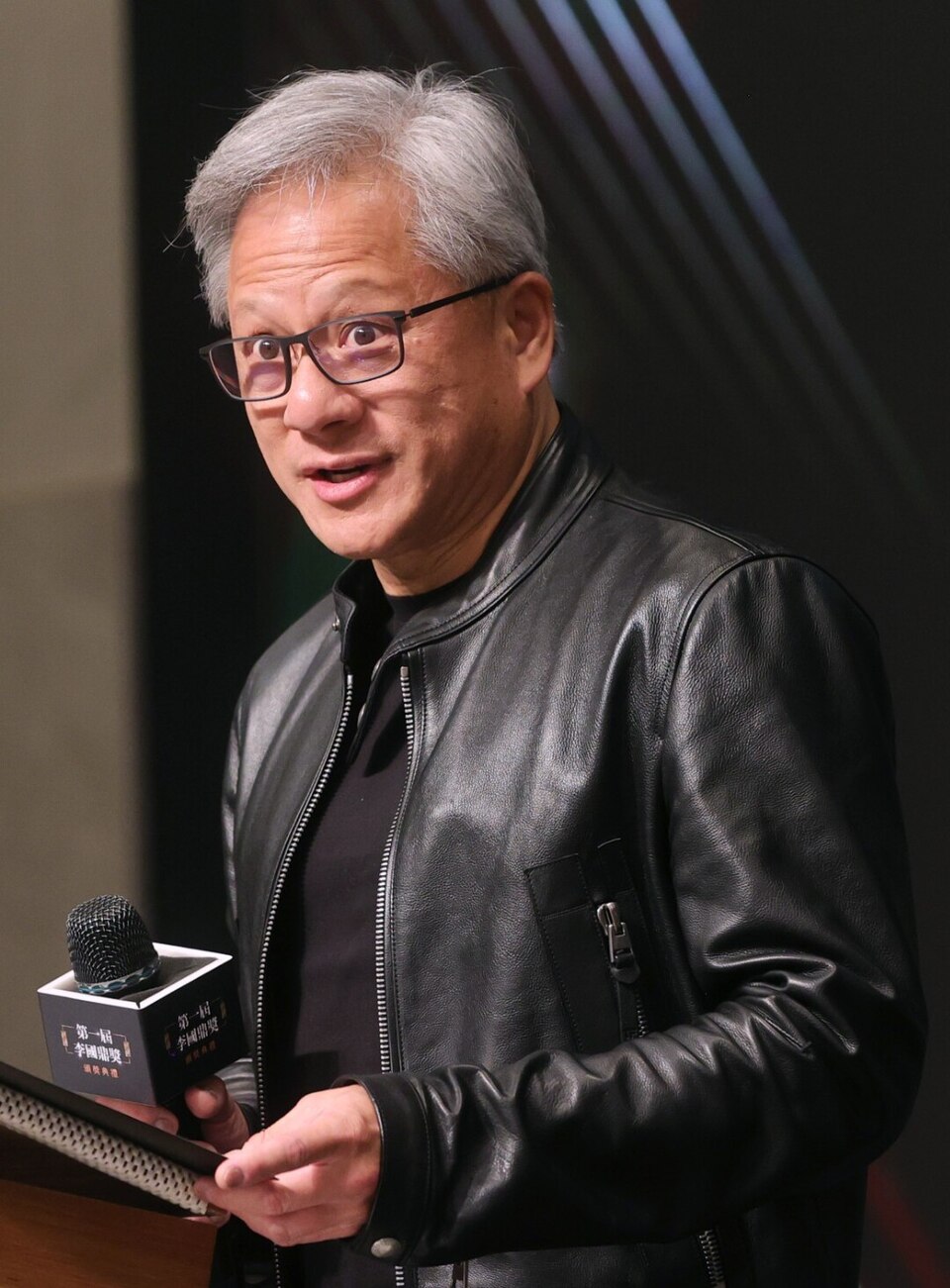
journey
Jensen Huang was born in Tainan, Taiwan in 1963. His family moved to Thailand when he was five, and at nine he and his older brother were sent to live with an uncle in the United States. The uncle enrolled them at Oneida Baptist Institute in Kentucky, mistakenly believing it was a prestigious boarding school; it was actually a religious reform academy, where Jensen cleaned toilets and shared a room with a seventeen-year-old former inmate who taught him to lift weights in exchange for math tutoring. His parents eventually followed to Oregon, where Jensen attended Aloha High School, skipped two grades, and became a nationally ranked table-tennis player. He earned a BSEE from Oregon State in 1984, worked at AMD and LSI Logic, and finished his master's at Stanford in 1992. In January 1993, over coffee at a Denny's in East San Jose, he met Curtis Priem and Chris Malachowsky and sketched a company that would make PCs render real 3D graphics. He was twenty-nine.
struggles
Nvidia's first product, the NV1, was a technical cul-de-sac. It used quadratic texture mapping while the industry standardized on triangles, sold poorly, and was effectively dead within a year. The follow-up, NV2, was built for Sega's next console. In 1996 Sega pulled the contract. Nvidia had three million dollars in the bank, was burning three hundred and thirty thousand a month, and Jensen laid off roughly half the company. Sega's U.S. president, convinced the team was worth saving, wired a five-million-dollar lifeline. Nvidia abandoned its proprietary approach, adopted Direct3D, and shipped the RIVA 128 in August 1997; it sold a million units in a few months. For the next decade, Huang grinded through the brutal consolidation of the 3D graphics market, outlasting dozens of competitors who were once better funded and better reviewed. Patience became the house style.
success
GeForce turned Nvidia into the gaming graphics leader. Then in November 2006, Huang launched CUDA, a software layer that let developers run general-purpose parallel code on every Nvidia GPU, from the cheapest consumer card to the top of the stack. Wall Street hated it. The valuation fell from roughly twelve billion to the low single-digit billions, and the market punished Nvidia for burning cash on a developer platform with no obvious customers. Huang kept shipping CUDA on every chip, year after year, for a decade. In 2012 a neural network called AlexNet, trained on Nvidia GPUs with CUDA, won the ImageNet contest and launched the deep-learning era. The payoff accelerated with data-center GPUs, the H100, and the generative-AI boom. By 2024 Nvidia had crossed a three-trillion-dollar market capitalization, and Huang's thirty-year compounding looked, finally, like an overnight success.
lessons
Huang's career is a case study in refusing short-term optics. He bet on CUDA when it crushed margins and the stock. He kept the same three co-founders aligned, kept himself in the CEO chair for every quarter of the company's life, and treated a near-bankruptcy in 1996 as a lesson rather than a trauma. The deepest takeaway for founders is that durable monopolies tend to be built from unglamorous decisions compounded over long time horizons: ship the unpopular platform, standardize the ecosystem, pay the tax now so you own the rails later. Huang also demonstrates something quieter — that a founder's role in a technical business is to protect the long-term bet from the quarter-to-quarter politics that otherwise kill it. Thirty years is not an exception in this industry. It is the price of admission.
Track record
Operating principles
Pay the cost of the platform now
CUDA ran on every Nvidia GPU for a decade before it had a mass market. Huang paid the margin tax every year because the only way to own a platform is to make it ubiquitous before anyone asks for it.
Near-death is a teacher, not a story
In 1996 Nvidia had weeks of runway. Huang laid off half the team, scrapped the proprietary tech, and shipped a standards-compliant chip. He rarely dramatizes the moment; he treats it as the lesson that set every policy after it.
Stay in the chair
Huang has been CEO every day since 1993. The compounding that produced Nvidia is inseparable from one person refusing to leave, refusing to split, and refusing to optimize for the next quarter.
Tell your network. Pre-filled text for LinkedIn and X — edit however you like.
Copy and paste this into your site or bio page.
<a href="https://theentrepreneurstory.com/founders/jensen-huang" target="_blank" rel="noreferrer" style="display:inline-flex;align-items:center;gap:8px;background:#1a2e1a;color:#f4efe1;font-family:sans-serif;font-size:13px;padding:10px 16px;border-radius:4px;text-decoration:none;">As featured in · The Entrepreneur Story</a>Selected coverage
Want your story here?
Submit your founder profile.
Like Jensen, hundreds of founders have been featured on The Entrepreneur Story. Reviewed weekly — submit yours in under two minutes.
Submit your story →