
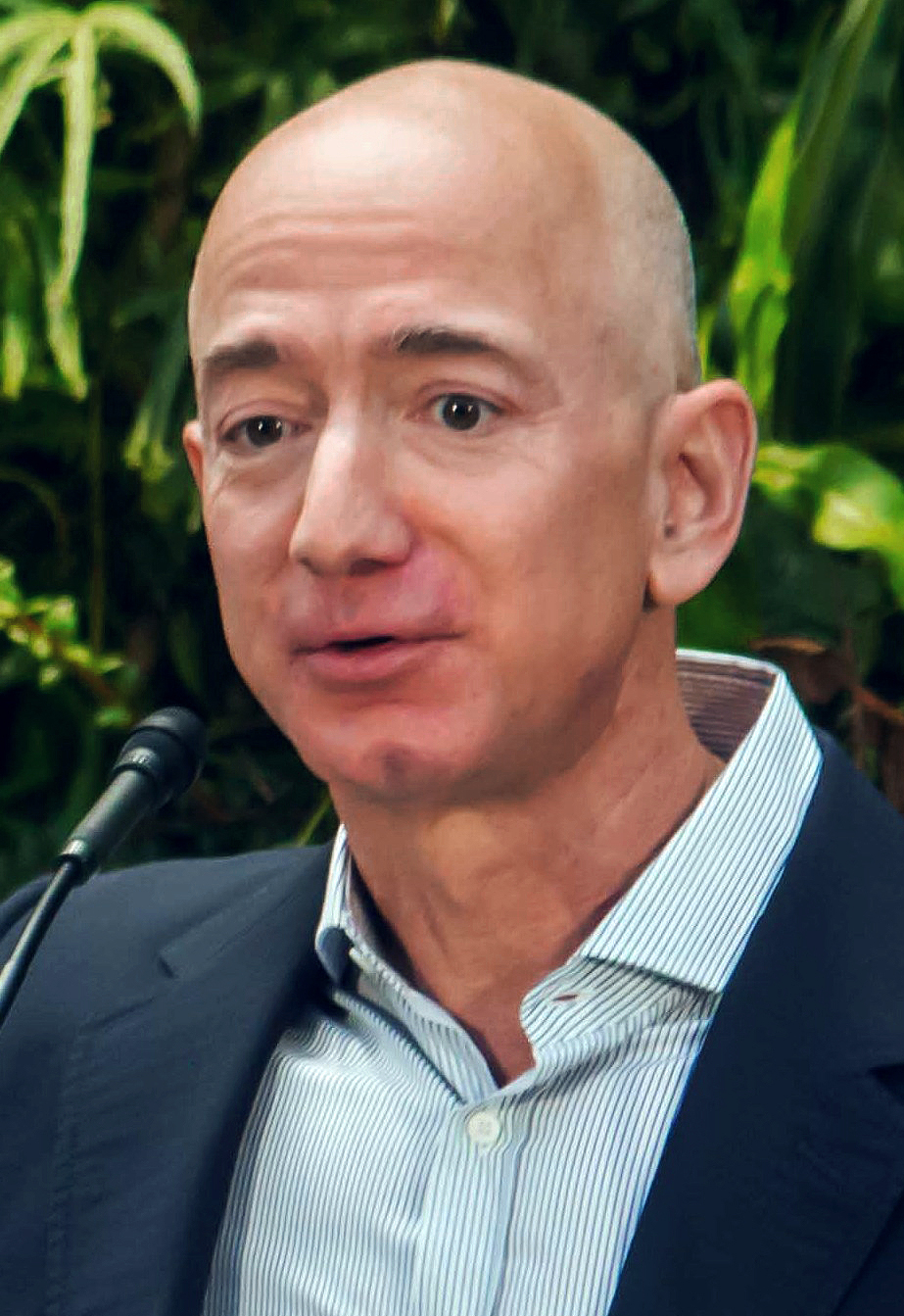
Jeff Bezos.
Wall Street quant who left a cushy VP job to sell books from a Bellevue garage, then built the everything store and the cloud underneath it.
journey
Born in Albuquerque in 1964 and raised in Houston and Miami, Bezos graduated from Princeton in 1986 with degrees in electrical engineering and computer science. He joined D.E. Shaw, a quantitative hedge fund that used computer science to understand the markets, and by his late twenties he was a senior vice president. In 1994 he stumbled on a statistic claiming internet usage was growing 2,300 percent a year. He raised the idea of an online store with his boss, David Shaw, during a two-hour walk in Central Park. Shaw agreed it was a good idea, just not for someone who already had a good job. Bezos resigned anyway. He and his then-wife MacKenzie drove from New York toward Seattle while he typed the business plan on a laptop in the passenger seat. The first Amazon office was the converted garage of a rented house in Bellevue, Washington. Books came first because the catalogue was already digitised and no single retailer dominated.
struggles
Amazon reached the public markets in 1997 and became a dot-com darling, but the party ended quickly. Between 1999 and 2001 the stock collapsed from about 106 dollars to roughly 6, a drawdown of around 94 percent. Bezos's own paper net worth fell from more than 10 billion dollars in 1999 to under 2 billion by 2002. Analysts openly predicted bankruptcy and nicknamed the company Amazon.toast. The firm cut about 15 percent of its staff, raised convertible debt in Europe just before the window shut, and pushed every unit toward unit economics that actually worked. The real tension was philosophical: Wall Street wanted quarterly profit, Bezos wanted to keep spending on fulfilment centres, third-party marketplace infrastructure and, eventually, server capacity nobody else was asking for. He chose the long game, repeated his shareholder letter promise to invest for the long term, and kept writing the same first letter from 1997 as an appendix every year.
success
Amazon turned its first profit in the fourth quarter of 2001, six years after launch. From there Bezos widened the aperture ruthlessly: music and video, then Marketplace for third-party sellers, then Prime in 2005, then Amazon Web Services in 2006. AWS began as an answer to Amazon's own internal infrastructure problem and ended up renting that infrastructure to almost every startup of the following decade, becoming the operating profit engine that funded everything else. Kindle launched in 2007 and reset digital reading. The acquisitions of Zappos, Whole Foods and MGM extended the store into shoes, groceries and streaming. Blue Origin, founded quietly in 2000 and funded by Bezos selling roughly a billion dollars of Amazon stock a year, flew him to the edge of space on New Shepard in July 2021. He stepped down as Amazon CEO that same month, handing the role to Andy Jassy.
lessons
Bezos's clearest decision tool is the regret minimisation framework. Faced with leaving D.E. Shaw, he projected himself to age 80 and asked which choice he would regret more: trying and failing, or never having tried. The failure of the startup barely registered at 80. Not trying did. The second idea is Day 1. In every shareholder letter he insisted Amazon was still on its first day, because Day 2, in his words, is stasis followed by irrelevance followed by death. Day 1 meant obsessing over customers rather than competitors, accepting that most big bets would fail, and designing processes to be reversible wherever possible. The third is time horizon arbitrage. If you are willing to think in five to seven year cycles, you compete against almost nobody. Most of the market is thinking about this quarter.
Track record
Operating principles
Regret Minimisation
Project yourself to 80 and work backward. The decisions that look risky at 30 almost never look risky at 80. The ones that look safe often do.
Stay on Day 1
Day 2 is stasis. Fight it with customer obsession, resistance to proxies, eager adoption of external trends and fast, high-quality decisions.
Disagree and Commit
Don't wear people down to consensus. Say you disagree, then commit fully if the owner decides to proceed. It beats slow politics every time.
Tell your network. Pre-filled text for LinkedIn and X — edit however you like.
Copy and paste this into your site or bio page.
<a href="https://theentrepreneurstory.com/founders/jeff-bezos" target="_blank" rel="noreferrer" style="display:inline-flex;align-items:center;gap:8px;background:#1a2e1a;color:#f4efe1;font-family:sans-serif;font-size:13px;padding:10px 16px;border-radius:4px;text-decoration:none;">As featured in · The Entrepreneur Story</a>Selected coverage
Want your story here?
Submit your founder profile.
Like Jeff, hundreds of founders have been featured on The Entrepreneur Story. Reviewed weekly — submit yours in under two minutes.
Submit your story →