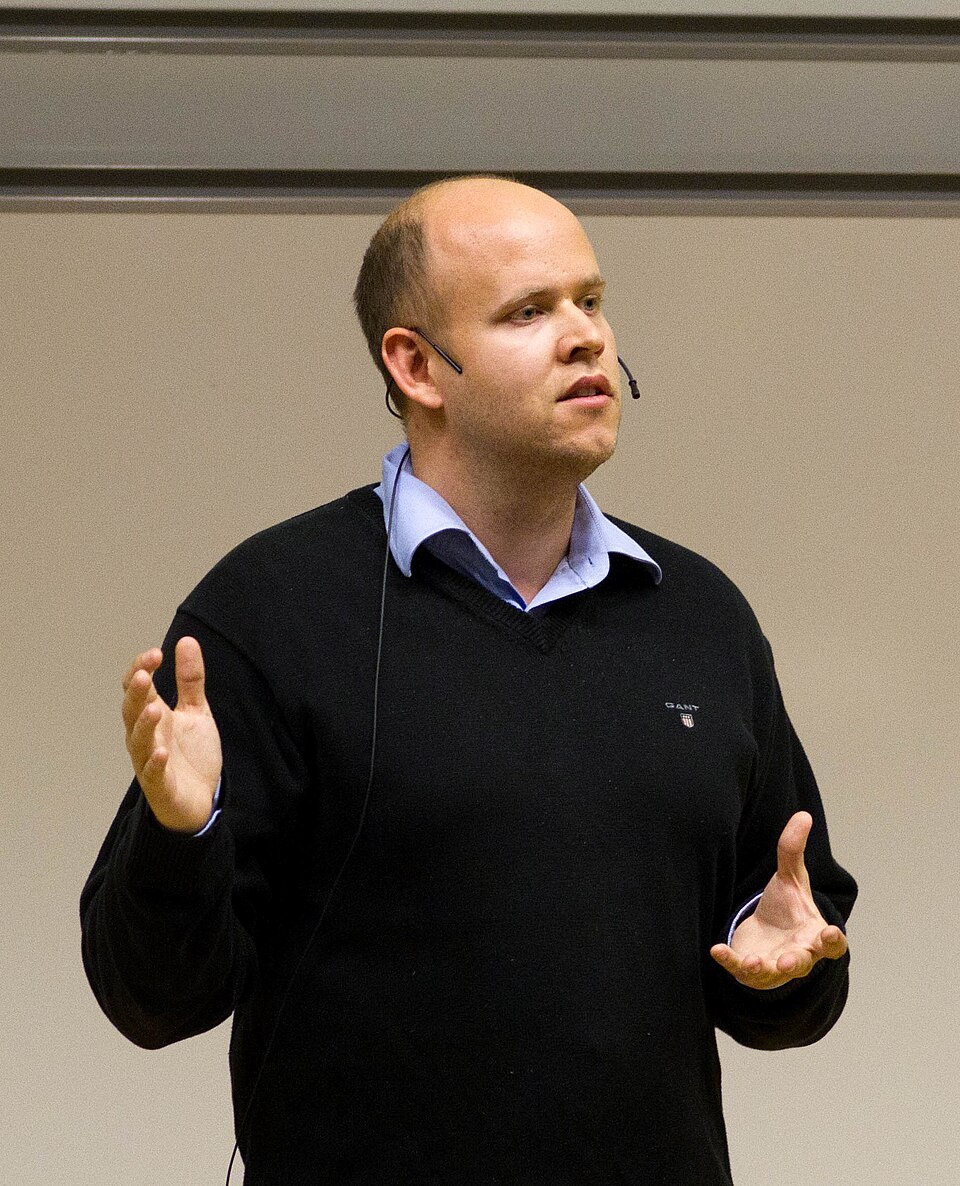
Daniel Ek.
The Stockholm coder who out-engineered piracy by giving listeners something better than free.
journey
Daniel Ek grew up in Rågsved, a working-class suburb south of Stockholm, in a family where his grandmother had sung opera and her husband played jazz piano. He picked up a guitar at four, started using a computer at five, and was writing code by thirteen. At fourteen he was building websites for small businesses, and by sixteen he was running a small team of classmates and earning more than his parents. He enrolled in engineering at KTH Royal Institute of Technology but dropped out within months. A string of operator roles followed: senior work at the Nordic auction startup Tradera, CTO of the fashion community Stardoll, and the founder of an online advertising company called Advertigo, which Tradedoubler acquired in 2006. That deal put Ek in a room with Tradedoubler co-founder Martin Lorentzon, and the two agreed to try something harder.
struggles
The idea was simple to describe and brutal to execute: a legal, free, instant alternative to Napster, LimeWire, and The Pirate Bay. Convincing the four major labels — Universal, Sony, Warner, and EMI — was another matter. Each one initially refused. The music industry had spent nearly a decade suing its own customers and watching CD revenue collapse; a Swedish 23-year-old promising to fix it with ad-funded streaming did not inspire confidence. Ek spent roughly two years in licensing negotiations before Spotify could legally play a single song in Europe. He eventually broke the deadlock by offering the labels equity stakes in Spotify itself, aligning their incentives with the platform's survival rather than its destruction. The U.S. launch took another three years of talks and finally arrived in July 2011.
success
Spotify launched in October 2008 across a handful of European markets and reached the United States in July 2011. On April 3, 2018, the company bypassed the traditional IPO process and did a direct listing on the New York Stock Exchange, closing its first day at a $26.6 billion valuation and briefly touching nearly $30 billion. Ek's roughly 9 percent stake made him a billionaire on paper that afternoon. The service has kept compounding: Spotify reported 713 million monthly active users and 281 million paying Premium subscribers as of September 30, 2025. Along the way it reshaped how the industry pays artists, how podcasts are distributed, and how listeners discover new music.
lessons
Ek's story is a case study in negotiating with incumbents who would rather you did not exist. He did not try to replace the labels or route around them — a mistake earlier music startups had made and lost to. He treated them as partners who needed a reason to say yes, and he found that reason by giving them ownership of the thing they feared. The second lesson is patience under uncertainty: two years of licensing talks before launch, three more before reaching the United States, and years of unprofitable scale after that. The third is his original thesis, which still travels well to any category dominated by piracy, friction, or legacy pricing: people do not steal because they are cheap, they steal because the legal option is worse. Build a legal option that is better, and the behavior changes on its own.
Track record
Operating principles
Beat piracy with convenience, not lawsuits
People pirate when the legal path is slower, uglier, or more restrictive than the illegal one. Ek's entire pitch was that a well-designed free tier would convert pirates faster than any court ever could. Fix the user experience and the moral argument becomes unnecessary.
Give incumbents a reason to say yes
The labels did not need to be convinced that streaming was coming. They needed to be convinced they would survive it. Offering equity turned four blockers into four co-owners, which is why the deals finally closed after two years of refusals.
Pick a market where the status quo is already breaking
Ek did not try to disrupt a healthy industry. He walked into one that was already losing badly to Napster and the Pirate Bay. The hardest work was not inventing streaming — it was being the person patient enough to sit at the licensing table until everyone else was tired.
Tell your network. Pre-filled text for LinkedIn and X — edit however you like.
Copy and paste this into your site or bio page.
<a href="https://theentrepreneurstory.com/founders/daniel-ek" target="_blank" rel="noreferrer" style="display:inline-flex;align-items:center;gap:8px;background:#1a2e1a;color:#f4efe1;font-family:sans-serif;font-size:13px;padding:10px 16px;border-radius:4px;text-decoration:none;">As featured in · The Entrepreneur Story</a>Selected coverage
Want your story here?
Submit your founder profile.
Like Daniel, hundreds of founders have been featured on The Entrepreneur Story. Reviewed weekly — submit yours in under two minutes.
Submit your story →