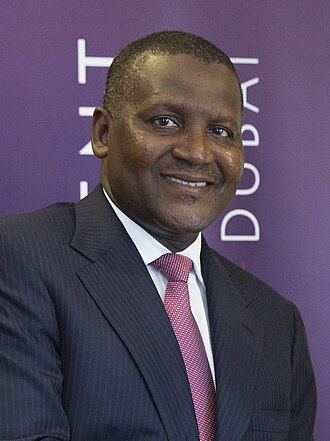
Aliko Dangote.
Nigerian industrialist who turned a borrowed trading loan into Africa's largest cement producer and the continent's biggest oil refinery.
journey
Born in Kano in 1957 into the influential Dantata trading family, Dangote absorbed commerce early — he famously sold sweets to classmates as a child. After his father died when he was eight, his maternal grandfather and uncle, cement and commodities magnate Sanusi Dantata, shaped his upbringing. In 1977, aged 21 and fresh from studies at Al-Azhar University in Cairo, Dangote took a loan reportedly worth around $3,000 from his uncle and began trading cement, sugar and rice in Lagos. The business was profitable fast enough that he repaid the loan within three months. In 1981 he incorporated what would become Dangote Group, scaling from a Lagos trading house into West Africa's dominant importer of bulk commodities. By the early 2000s he had begun the pivot that would define his career: moving from trading to manufacturing, and from Nigeria outward across the continent.
struggles
Building heavy industry in Nigeria meant absorbing problems most founders never meet. Power is unreliable, so Dangote plants generate their own. Ports are congested, so the group built jetties. The naira has repeatedly devalued, inflating dollar-denominated capex and debt. The refinery alone — originally budgeted around $9 billion — ballooned past $20 billion as COVID-19, currency depreciation and inflation compounded. Regulatory friction with Nigerian oil authorities, crude-supply disputes and years of construction delays pushed the refinery's start-up from 2016 to 2024. Dangote has publicly said that had he known what the project would entail, he would not have begun it. Beyond infrastructure, he operates in markets where consumer purchasing power is thin and import mafias actively lobby against local manufacturing. Each new plant has had to overcome not just engineering but politics.
success
Dangote Cement is now Sub-Saharan Africa's largest cement producer, with roughly 55 million tonnes of annual capacity across ten African countries, from Nigeria and Ethiopia to Senegal, Tanzania and Cameroon. Its 2015 IPO made it one of the most valuable listings on the Nigerian Exchange. In January 2024 the Dangote Petroleum Refinery began production in the Lekki Free Zone outside Lagos — a 650,000-barrel-per-day single-train facility, the largest in Africa and the largest single-train refinery in the world. The project is designed to end Nigeria's absurd status as a crude exporter that imports refined fuel. In 2025 the group announced a $14.3 billion expansion aimed at 1.4 million barrels per day by 2029, and Dangote has signalled plans for a $17 billion refinery in Kenya.
lessons
Dangote's career is the clearest modern case study of industrial founding in a frontier market. First, he treats infrastructure as part of the product: if the state cannot supply power, roads or ports, you build them into your capex and price them in. Second, he scales in the category he already understands — trading cement taught him demand curves before he poured a single kiln. Third, he is patient about time horizons that would terrify a Western CFO; the refinery took more than a decade. Fourth, he is willing to be unpopular with the import lobby, because substitution is where the margin is. For founders in emerging markets, the takeaway is not that everyone should build refineries. It is that the biggest opportunities often sit behind the problems everyone else treats as reasons not to start.
Track record
Operating principles
Make what your country imports
Dangote's entire industrial strategy is substitution. Cement, sugar, fertiliser, now refined fuel — each business targeted a category Nigeria was spending foreign exchange to import. Find the import line item that keeps growing and build inside it.
Build the infrastructure into the business
In markets with weak public infrastructure, do not wait for the state. Dangote plants come with their own power, their own jetties, their own logistics. Price that cost in from day one rather than pretending it will be solved by someone else.
Patience is a competitive moat
The refinery took more than a decade and tripled in cost. Most competitors would have abandoned it. In frontier industry, the willingness to carry a project through currency crises, political cycles and cost overruns is itself the edge.
Tell your network. Pre-filled text for LinkedIn and X — edit however you like.
Copy and paste this into your site or bio page.
<a href="https://theentrepreneurstory.com/founders/aliko-dangote" target="_blank" rel="noreferrer" style="display:inline-flex;align-items:center;gap:8px;background:#1a2e1a;color:#f4efe1;font-family:sans-serif;font-size:13px;padding:10px 16px;border-radius:4px;text-decoration:none;">As featured in · The Entrepreneur Story</a>Selected coverage
Want your story here?
Submit your founder profile.
Like Aliko, hundreds of founders have been featured on The Entrepreneur Story. Reviewed weekly — submit yours in under two minutes.
Submit your story →