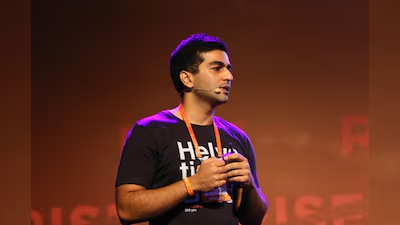
In a significant development for India’s startup ecosystem, Kavin Bharti Mittal, founder and CEO of Hike, announced the complete shutdown of the company. The decision comes in the wake of the Indian government’s ban on real-money gaming (RMG), a move that has disrupted business models across the gaming and digital entertainment sectors.
In a heartfelt post on LinkedIn, Mittal reflected on Hike’s journey and the strategic reasons behind the closure. While Hike’s US operations had shown promising traction since their launch nine months ago, continuing global operations would have required a complete recapitalisation. Mittal candidly noted, “After the India ban, scaling globally would require a full recap, a reset that is not the best use of capital or time.”
Hike will use its remaining $4 million balance for vendor payments and employee severance, with any remaining funds returned to investors. Mittal described the move as a decision to “close a chapter and open a new one,” signaling that while Hike’s operations are ending, the entrepreneurial journey for its team and founder is far from over.
A Look Back at Hike’s Journey
Founded in 2012 as a messaging platform, Hike once rivaled global giants with over 100 million users. It was lauded for bringing innovative features to Indian users, including stickers, local language support, and mobile-first social engagement, at a time when WhatsApp dominated the messaging space. In 2021, Hike Messenger was officially shut down, marking the first major pivot for the company.
Following the shutdown of its messaging app, Hike pivoted into gaming and Web3 technologies. The company launched two new products: Vibe, a community platform, and Rush, a real-money gaming service. Rush, in particular, scaled rapidly, amassing 10 million users and generating $500 million in gross revenue over four years. Despite these impressive numbers, the company faced recurring regulatory challenges and tax disputes, which became increasingly difficult to navigate in light of the government’s RMG ban.
Mittal explained that RMG was never the ultimate goal for Hike. “RMG was never the destination. It was a means to prove unit economics and unlock the bigger vision. But we got locked into the Indian market in a tax/regulation battle,” he wrote. This statement underscores the strategic intentions behind Hike’s shift into gaming — testing the viability of its business model and exploring monetization avenues — while highlighting the limitations imposed by regulatory hurdles.
Regulatory Challenges and the RMG Ban
The recent ban on real-money gaming in India proved to be a decisive factor in Hike’s closure. While the sector had grown rapidly and attracted millions of users, the regulatory environment has remained uncertain, with multiple states enforcing restrictions and the federal government tightening compliance requirements. For startups like Hike, whose pivot relied on RMG revenue, such policy changes can quickly render business models unviable.
Recurring tax disputes and legal battles further complicated the scenario. Despite generating substantial revenue from Rush, Hike’s global expansion plans required a stable regulatory framework. Mittal emphasized that continuing operations under the existing conditions would have required a full recapitalisation — a move that would not have been an efficient use of capital or time for the company or its investors.
Reflections from the Founder
Mittal’s LinkedIn post reflected both the challenges and achievements of Hike over 13 years. He highlighted the company’s evolution from a messaging app to a gaming and Web3 platform, underscoring the resilience and adaptability of the team.
“For the first time in 13 years, my answer is no. Not for me, not for my team, and not for our investors,” Mittal wrote. This candid acknowledgment shows the difficulty of the decision but also the clarity of vision in choosing to exit gracefully rather than persist under unsustainable conditions.
The closure also emphasizes a broader lesson for startups navigating fast-evolving sectors: market demand alone cannot guarantee sustainability. Regulatory clarity, tax compliance, and strategic foresight are equally critical for long-term survival and growth.
Employee and Investor Considerations
Hike’s closure was carefully planned to ensure employees and investors are treated fairly. The remaining $4 million on the company’s balance sheet will be used to settle vendor payments and employee severance, reflecting a responsible approach to winding down operations. Any residual funds will be returned to investors, demonstrating Mittal’s commitment to accountability and transparency.
The Future Beyond Hike
While Hike’s closure marks the end of a 13-year chapter, Mittal’s statement about “opening a new one” hints at continued entrepreneurial pursuits. The founder’s experience navigating multiple pivots, scaling products internationally, and tackling complex regulatory environments positions him well for future ventures.
Hike’s journey also leaves behind valuable lessons for India’s startup ecosystem. It underscores the importance of flexibility, the need to anticipate regulatory shifts, and the potential of testing monetization models in emerging sectors. While the company may no longer operate, its legacy in messaging, gaming, and innovation will continue to influence upcoming startups and entrepreneurs in India and beyond.
The complete shutdown of Hike is a poignant reminder of both the promise and challenges of the startup world. From a messaging app with over 100 million users to a gaming and Web3 venture generating hundreds of millions in revenue, Hike’s journey illustrates ambition, adaptability, and resilience.
While regulatory challenges and market shifts ultimately determined the company’s fate, Hike leaves behind a blueprint for innovation and a team seasoned in navigating uncertainty. As Mittal closes this chapter, the startup ecosystem watches closely, anticipating the next move from a founder who has repeatedly demonstrated the courage to take bold risks and chart new territories.
Hike’s story may have ended, but its impact on Indian tech and digital entertainment will be remembered as a tale of innovation, perseverance, and lessons learned the hard way.