Bengaluru’s Traffic Woes Claim Another Victim
Bengaluru’s infamous traffic congestion has long been the subject of memes, rants, and policy debates. But now, it has pushed one of India’s leading logistics startups to move its office out of the city’s tech corridor.
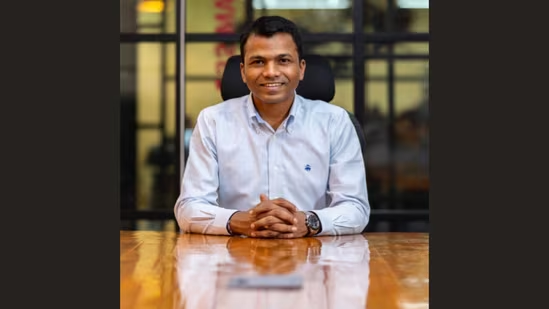
BlackBuck CEO and co-founder Rajesh Yabaji took to X (formerly Twitter) to announce that the company is exiting its Outer Ring Road (ORR) office in Bellandur after nearly a decade. His reason was blunt and unfiltered: pothole-ridden roads, dust-filled commutes, and endless traffic snarls that stretch travel time to more than 90 minutes one way.
“This place has been our office + home for nine years. But it’s now very-very hard to continue here. We have decided to move out,” Yabaji wrote. He added that he didn’t see any meaningful change happening “in the next five years.”
The Harsh Reality of Outer Ring Road
The Outer Ring Road (ORR) stretch between KR Puram and Silk Board is the beating heart of Bengaluru’s tech industry. But what was once designed as a bypass for heavy vehicles has, over time, transformed into a dense ecosystem of IT parks, residential apartments, and retail hubs.
- According to the Outer Ring Road Companies Association (ORRCA), this single stretch employs nearly 950,000 people across 500 companies.
- The corridor contributes a staggering 36% of Bengaluru’s annual IT revenue, making it a critical part of India’s tech economy.
But the concentration of companies also means overwhelming traffic. With firms increasingly mandating a return to office after years of remote and hybrid work, the pressure on ORR has worsened. What used to be a painful 45-minute drive is now a back-breaking 1.5 to 2-hour ordeal for many employees.
Dust, Potholes, and the Daily Struggle
Yabaji didn’t mince words when describing the day-to-day struggles faced by his employees. “The roads are full of potholes and dust, with little intent to fix them,” he said in his viral post.
The statement struck a chord with thousands of professionals who face the same reality daily. For many, the commute isn’t just about wasted hours—it’s also about declining health, lower productivity, and reduced quality of life.
Employees in the corridor report:
- Two to three hours spent in traffic daily.
- Higher stress levels and burnout linked to long commutes.
- Safety concerns due to poorly lit, poorly maintained stretches.
For a logistics company like BlackBuck—where operational efficiency and time management are core values—the situation was untenable.
Industry Leaders React: “Failure of Governance”
Yabaji’s post didn’t just spark outrage from employees and netizens; it also caught the attention of industry leaders.
Mohandas Pai, Infosys’ former CFO and chairman of Aarin Capital, called BlackBuck’s move a “big failure of governance in Bengaluru.” He urged state authorities to recognize the severity of the crisis and take swift action.
“This should be a wake-up call,” Pai said. “If companies start moving out because infrastructure cannot keep up, Bengaluru risks losing its hard-earned reputation as India’s Silicon Valley.”
The Bigger Picture: A Growing Urban Crisis
BlackBuck’s exit underscores a deeper urban planning issue that Bengaluru has been grappling with for years. Rapid, unplanned growth has outpaced the city’s infrastructure.
- Roads designed for bypass traffic now serve as daily commuter highways.
- Public transport capacity has failed to expand in step with the rising workforce.
- Metro projects, though promising, remain years away from offering full coverage in critical tech hubs.
The result: Bengaluru’s growth story risks becoming a victim of its own success.
What It Means for the Tech Ecosystem
While BlackBuck’s decision is a high-profile example, the frustration is widespread. Many startups and even large enterprises are quietly rethinking their office locations. Some are moving to secondary hubs like Whitefield and North Bengaluru, while others are experimenting with hub-and-spoke office models to cut commute times.
If more companies follow BlackBuck’s lead, Bengaluru could see:
- Shifting economic centers, with new micro-hubs developing outside ORR.
- Increased competition from other Indian cities like Hyderabad, Pune, and Chennai, which offer smoother commutes and more sustainable infrastructure.
- Pressure on the government to fast-track urban transport projects and road upgrades.
Can Bengaluru Fix Itself?
Experts believe the city still has a chance to fix its infrastructure challenges, but the window is narrowing. Expanding metro lines, building elevated corridors, and prioritizing public transport could ease the load on ORR.
However, without political will, accountability, and execution speed, commuters may continue to suffer—and companies may continue to leave.
Final Word: A Warning Bell for Bengaluru
BlackBuck’s exit from ORR is more than just one company’s relocation. It’s a wake-up call to the government, city planners, and industry leaders that Bengaluru’s infrastructure crisis can no longer be brushed aside.
If potholes, dust, and traffic jams can drive away a logistics unicorn, what message does that send to global investors evaluating India’s tech capital?
For now, Bengaluru remains India’s Silicon Valley. But unless the city tackles its traffic nightmare head-on, that title may not be secure for long.